
Can you explain MCP without using the word 'Protocol'?
You might know MCP. This blog explains how to explain MCP without using words like : 'Protocol' , 'Standard', 'USB-C'. If you can already do that, this blog is not for you!

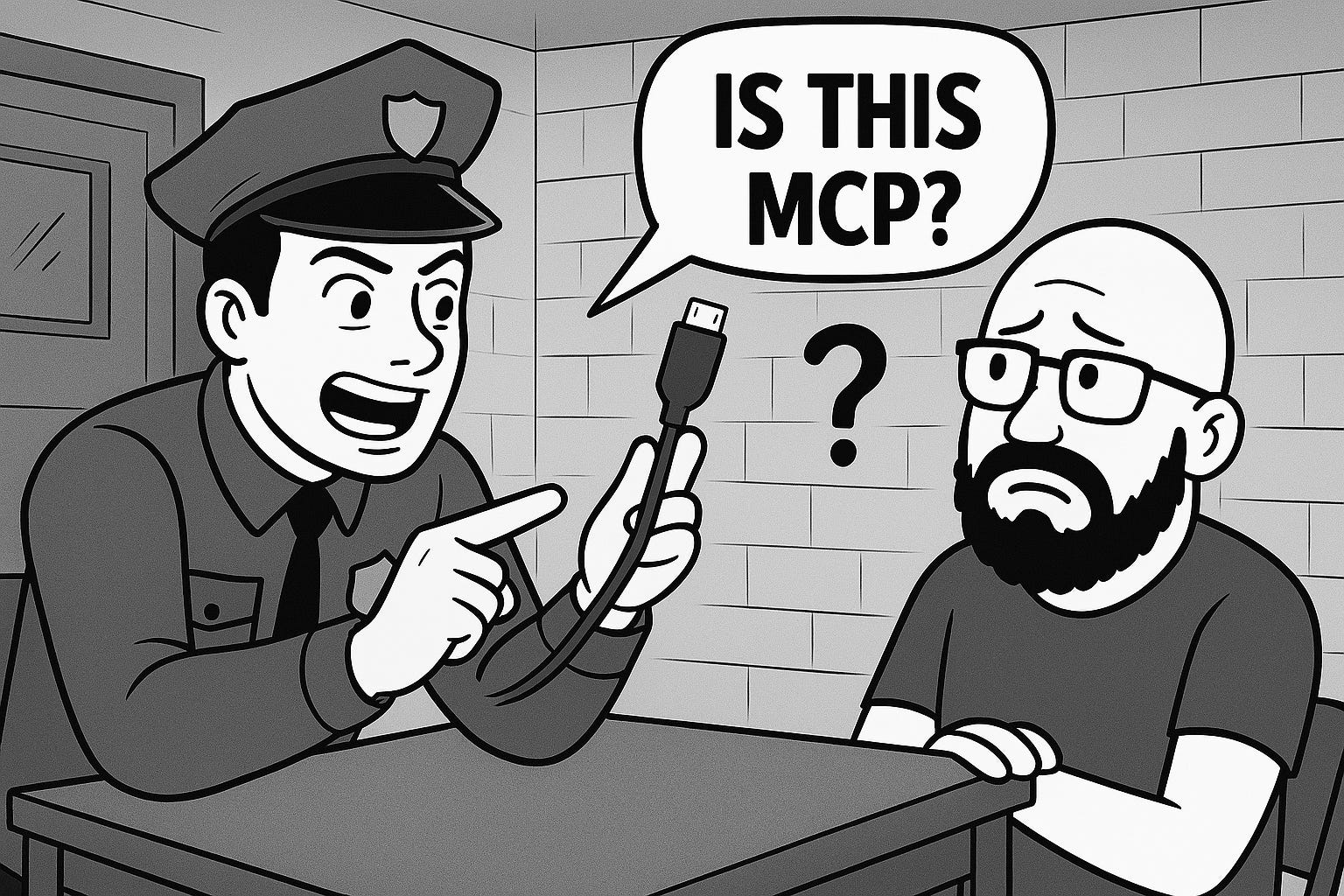
MCP is the universal USB-C of the AI world - is the most dumb independent statement to describe MCP. People could sure nod in their approval when they hear this, but that is because they understand what USB-C is not what MCP is.
It is like saying - ‘Cloud computing is the vending machine of storage’. Sure, it is. But what is Cloud Computing?
"Yes, Anthropic gave the USB-C analogy but they also wrote 190 pages and 29656 words to explain it along.
Explain MCP Game with Advanced AI Models -
I used O1 pro with appropriate context about MCP and asked for a definition multiple times, each time I asked to stop using certain words.
Grok
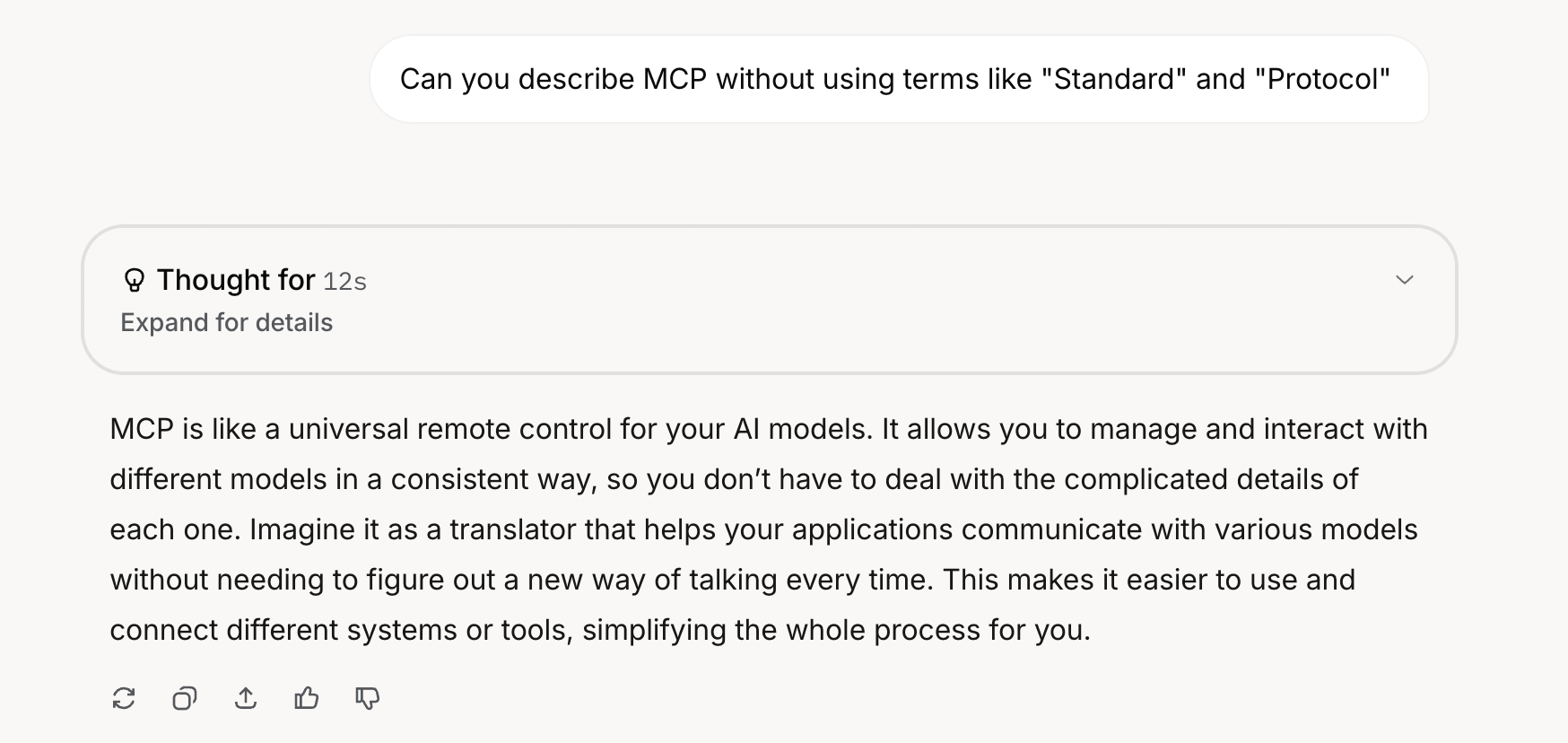
OpenAI O1
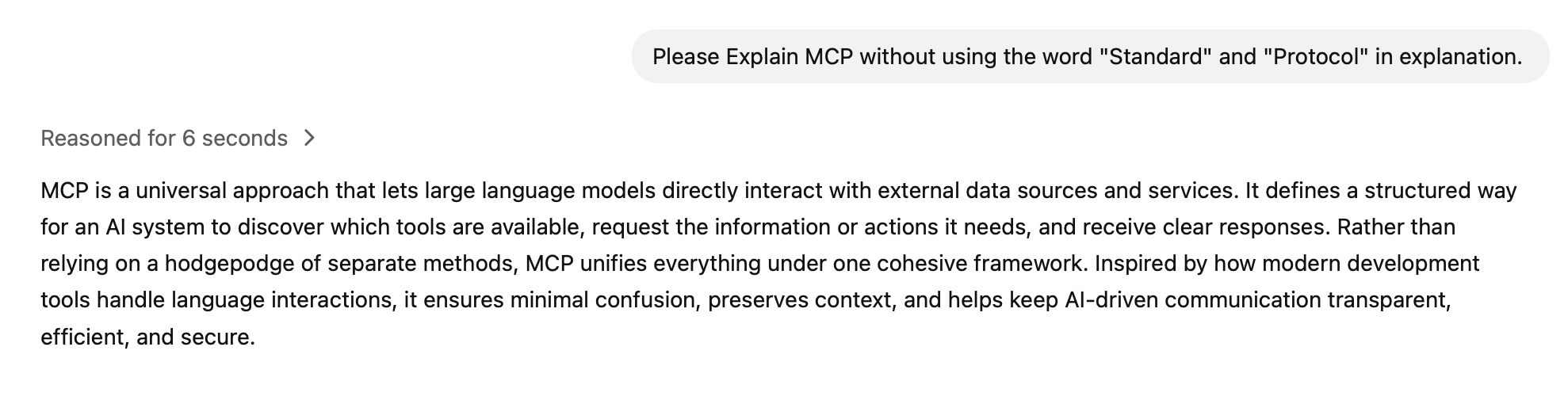
Claude
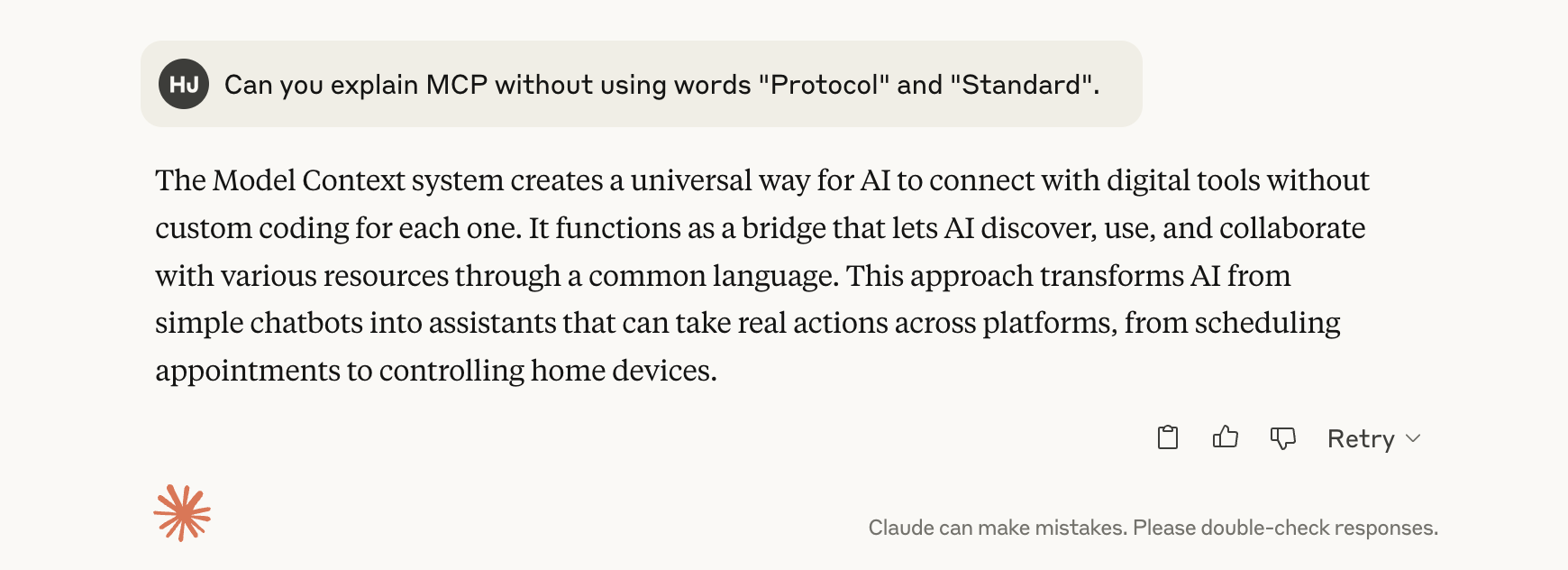
Still not there?
Let’s read the next 10 lines on what could have been -
Back when ChatGPT launched in 2022, it could only answer questions using information from before 2019.
It was because the “model” was trained on all publicly available data till 2019.
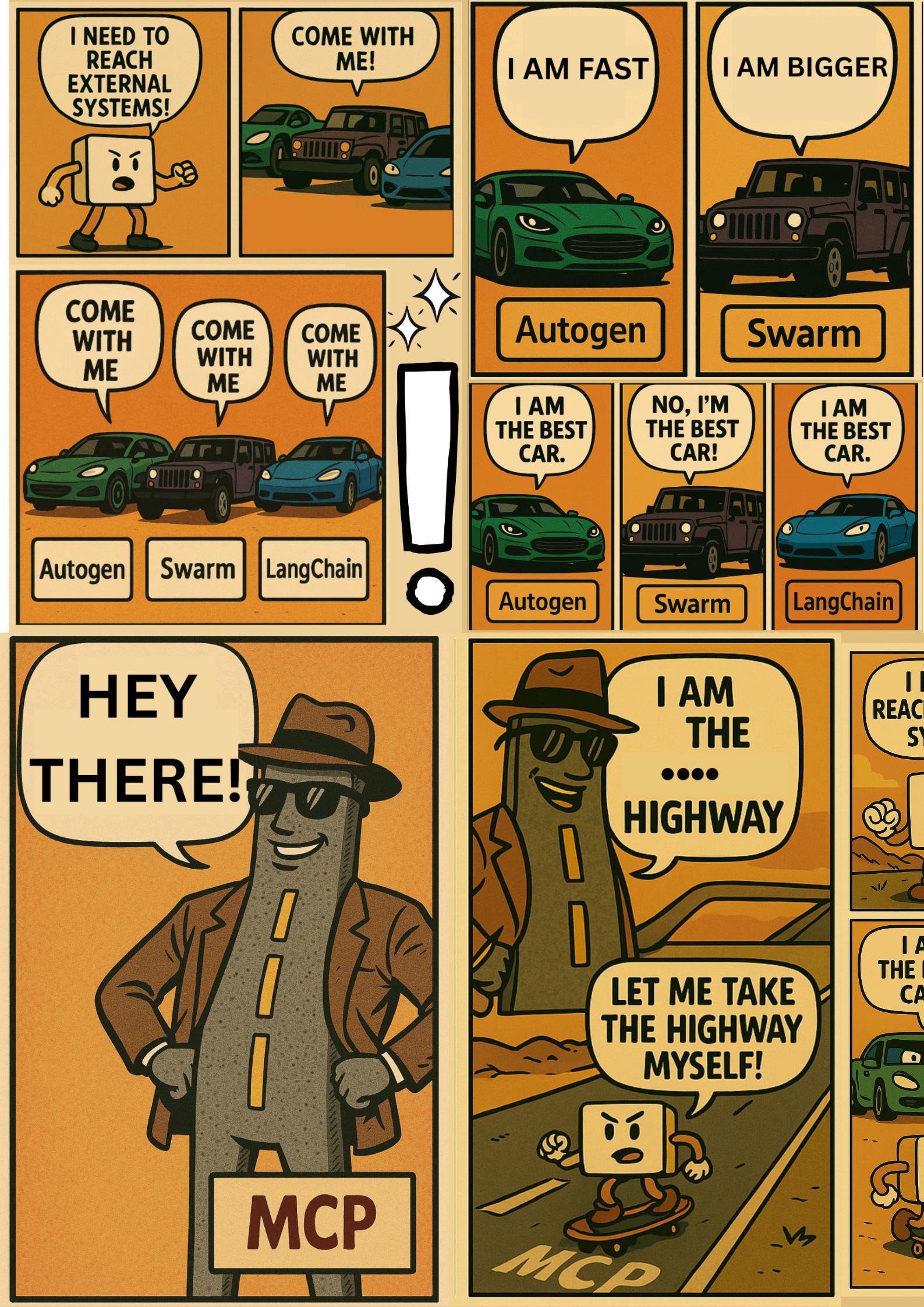
Then came “tool calling” to help it reach beyond - Plethora of agentic frameworks, using LLM as base.
These were layers on top of layers, each more sophisticated than the previous.
They’d allow fresh data to reach the underlying LLM, say stock prices or news. This made LLM use cases grow expotentially.
These frameworks and ‘tool calling ways’ could also bring information about this API exists in an external system, how to call it etc.
Also This multi stop communication across different layers made it slow, leaky and not uniform for different kinds of ‘contexts’ out there.
Every framework was different, some better than the others. Every layer did things differently, and they weren’t as smart as the model itself. (Technically just wrappers)
It turned into a bad game of telephone. Think of kids at a party whispering a secret: “Grandma baked a chocolate cake with sprinkles” starts clear, but by the end, it’s “Grandma raked a broccoli lake with pimples.” If this happens where complicated nuances like REST APIs, Code, DB Queries are involved, it’s a mess.
Each handoff b/w layers had the potential to twist context, drops bits, which meant API failed what to do was governed primarily by how those non consistent, distributed and non uniform layers were defined and written.
In time timeline, we would have seen every product writing their custom implementations of how to interact with LLMs. Perhaps many would not because the efforts needed might not just be worth it.
Enters MCP
Let’s read the next 10 lines on what is -
In later half of 2024 LLMs start becoming smarter and smarter.
But to truly flex, they need a clear shot at the outside world, not a knot of middlemen.
MCP enters to solve the old problem of - “tool calling ways” - But it comes not as a new platform or a new framework.
It said - If LLM would ever be in need to talk to it’s external environment → It should always talk in this new language that I know
It also said - If the external product/system wants to talk to LLM, then that will also have to speak this language.
But in their true natures, neither LLMs, not any external world system/product speaks that particular language.
So MCP said use two translators - One on LLM’s side and One on your system’s side.
These two translators speak the same language and translate for the LLM as well as the external environment whenever there is a need for these two to connect.
Because these “Translators” are doing nothing on their own, just translating and passing information it ensures there is no leak (losing context, lost in multiple layers etc).
It also ensures LLM can directly* reach external environment, see all things it can do there, and do those things.
In this timeline, because LLM’s interaction with external environment is actually just a connection without fluff, products who might not have invested in their own agents, have their MCP servers (translator on their side) which can talk to Claude using an MCP Client (translator on LLM side )
Okay Let’s conclude with that explanation!
So if MCP is the way to give LLM direct access to everything it does not have in it’s internal environment and MCP is also the way to enable external environments to become accessible to LLMs.
Shouldn’t MCP be defined as “Just a new language (or language translator?) that LLM and External Environment will use to talk with each other” ?
Choose what feels right!
While you are at explaning MCP, try - “Can you explain LLM evaluation without using the word “Vibe”?
Here’s a Fun take -

Disclaimer
Yes, this blog oversimplifies stuff. In doing so, it may omit certain technical details and nuances. MCP fundamentally is an open Standard and is a Protocol, so not using those words is just an oversimplification.
It is as technical as it can get. It is based on the Language Server Protocol (LSP), which standardizes how programming languages integrate with development tools. Similarly, MCP standardizes the integration of external data sources and tools with large language models (LLMs), ensuring seamless and efficient communication.
Find All things MCP including, some amazing MCP servers at TheMCP.AI - Coming Soon!